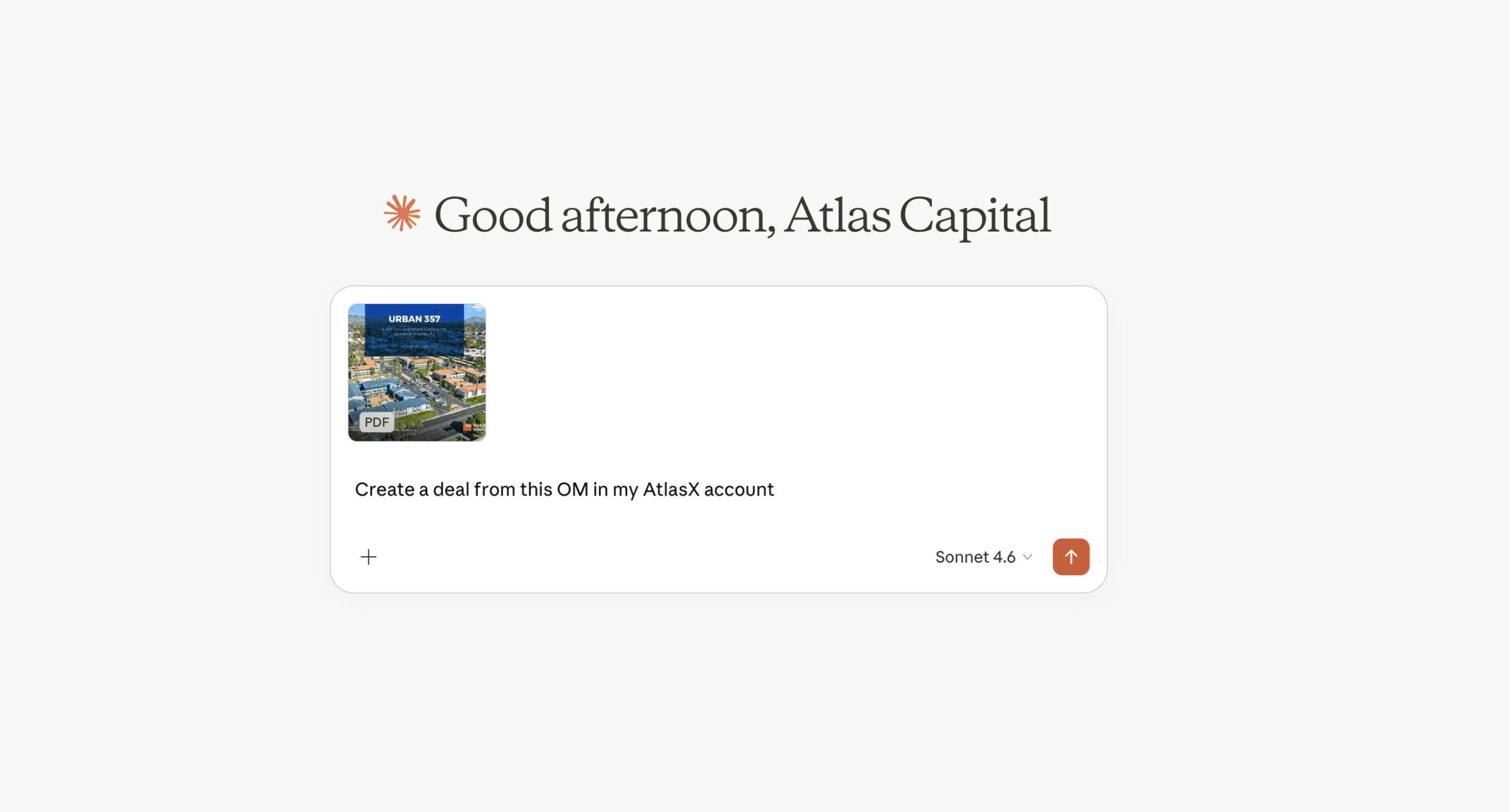
AtlasX now supports MCP, giving acquisitions teams a commercial real estate MCP server that connects Claude, ChatGPT, and other AI tools to their live deal pipeline.
That matters because AI tools are only as useful as the data they can access.
Commercial real estate firms have spent the last two years experimenting with AI to achieve operational alpha. ChatGPT for drafting memos. Claude for underwriting. Copilot for email. The tools are impressive in isolation, but they all run into the same problem: they do not know anything about your actual deals.
Every time you sit down with an AI assistant to work through something pipeline-related, you are starting from scratch. You paste in context. You describe where a deal stands. You upload reports out of your acquisition platform and into a chat window.
The AI is smart, but it is working blind.
For most CRE teams, the person is still the integration layer.
MCP changes that.
What an MCP Is
MCP stands for Model Context Protocol. It is an open standard developed by Anthropic and now supported across the AI industry that gives AI assistants a secure, structured way to connect to the tools and data sources your team already uses.
In plain English: MCP lets your AI assistant read from and write to business systems with the right permissions in place.
Instead of copying and pasting data into a chat, your AI can ask your pipeline tool for the right information, use that context to answer questions or complete work, and, when allowed, take action directly in the system.
MCP is to AI tools what APIs were to software integrations a decade ago. It is the connection layer that makes AI useful inside actual business workflows.
The CRE Data Problem
Commercial real estate is a data-intensive business.
A single acquisition can involve OMs, rent rolls, financial models, IC memos, broker relationships, offer rounds, due diligence timelines, market notes, and dozens of custom data points that vary by firm and strategy.
Most of that data lives in fragments.
Your pipeline tool has deal stages and statuses. Your spreadsheets have underwriting assumptions. Your email has broker conversations. Your shared drive has OMs. Your team has notes, comments, and context spread across different places.
None of it is easily accessible to the AI tools your team is starting to rely on.
The result is that AI in CRE has mostly been a copy-paste workflow. Useful, but manual. Powerful, but disconnected.
MCP changes the architecture.
When your pipeline tool supports a commercial real estate MCP server, your AI assistant can query it directly. It can pull live deal data, filter by stage or market or offer status, read contact records and comments, and write updates back without you acting as the middleman.
That is the real promise of MCP in commercial real estate: not replacing the acquisitions team, but removing the operational drag around managing deal data.
What This Unlocks for Acquisitions Teams
Once your AI tools are connected to your live deal pipeline, the use cases become concrete quickly.
Faster pipeline searches
Instead of logging into your platform and building a filtered view, ask Claude what active acquisitions are in underwriting in the Northeast and get a live answer from your actual pipeline data.
Less manual deal intake
When a broker sends an offering memorandum, you can drop it into Claude and ask it to create a new deal record.
With an MCP connection to your pipeline tool, the AI can read your account’s field configuration, including property details, investment metrics, key dates, location data, and custom fields, then populate the record automatically.
What used to take minutes of manual entry can take seconds.
Better IC memos and internal updates
AI is already useful for drafting memos, summaries, and internal updates. But the output is only as good as the context you provide.
With MCP, your AI assistant can pull the full deal record, including fields, contacts, companies, recent comments, and status history, then use that context to draft an IC memo, investment summary, or partner update.
The AI is writing from your actual deal data, not a rough description of it.
Cleaner relationship tracking
Acquisitions teams rely heavily on relationships with brokers, sellers, buyers, lenders, and other transaction parties.
With an MCP-connected pipeline, you can add people and companies to deals with the right roles attached as soon as you learn about them.
Updates that stay in the system of record
A lot of deal context gets lost because updates happen in conversations, emails, and chats but never make it back into the pipeline.
With MCP, your AI assistant can post comments and updates back to the deal record, so the context your team creates is captured where the rest of the team can find it.
A Simple Example
Imagine a broker sends over a new OM.
You upload it to Claude and ask it to create a deal in AtlasX.
Claude reads the OM, extracts the property details, market, asset type, pricing guidance, key dates, broker information, and investment highlights. Through the AtlasX MCP server, it checks your firm’s deal fields, creates a new deal record, associates the broker and company, adds the relevant comments, and drafts a short internal summary for your team.
The work still gets reviewed by a person. But the repetitive parts of intake, data entry, and first-pass summarization happen much faster.
AtlasX Now Supports a CRE MCP Server
AtlasX is a deal pipeline management platform built specifically for commercial real estate acquisitions teams.
We help firms track deal flow across stages, markets, property types, offer rounds, and transaction lifecycles, with custom fields that match how each firm actually underwrites and evaluates opportunities.
We just shipped a CRE MCP server that makes AtlasX data accessible to Claude, ChatGPT, and other AI tools that support MCP.
The AtlasX MCP server is purpose-built for commercial real estate acquisitions workflows, exposing 19 tools covering deals, contacts, companies, comments, and deal associations. You can search and filter the pipeline, pull full deal records, create and update deals, manage transaction parties by role, and post comments, all from your AI assistant.
Access is controlled through the MCP connection and the permissions configured for your AtlasX account.
Setup takes a few minutes.
If you are an existing AtlasX customer, head to our help article for instructions on connecting the MCP server to your Claude or ChatGPT account.
If you are not yet using AtlasX and want to see this in action, book a demo and we will walk you through how AtlasX connects AI tools directly to live pipeline data.
The Firms That Move First Have an Advantage
MCP adoption in commercial real estate is still early.
Most acquisitions teams are still using AI as a standalone tool. Helpful for drafting and analysis, but disconnected from the live pipeline data that drives actual deal work.
The data layer has always been the hard part of AI in CRE.
MCP makes it solvable.