The 5 Levels of AI in Commercial Real Estate (And How to Know Where You Are)

John Ledger
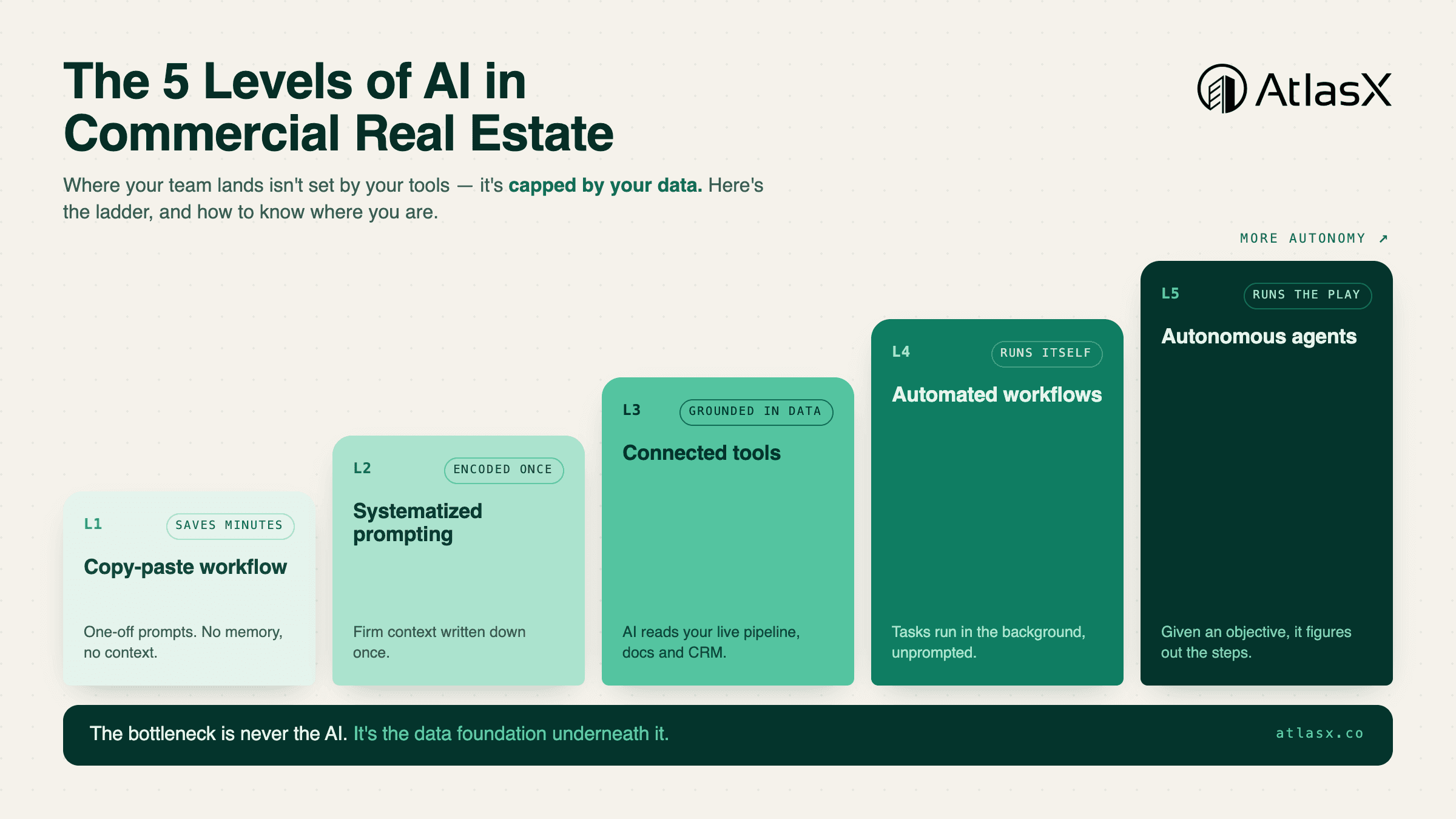
Most CRE teams think they’re using AI. They’re not. They’re using a very fast search engine.
There’s a real gap between using AI to tighten an IC memo and having it actually move a deal forward — and where you sit in that gap isn’t about how good your AI tools are. It’s about your data. The level you can reach is capped by what your AI can see, query, and reason over. Most teams hit that ceiling long before they realize the ceiling is the problem.
So this isn’t a “we use AI” or “we don’t” question. There’s a ladder, and your position on it determines whether AI is saving you twenty minutes a day or changing how your team underwrites and closes. Here are the five levels, what each looks like in practice, and the signal that tells you it’s time to climb.
Level 1 — The Copy-Paste Workflow
“I use ChatGPT sometimes.”
An associate reviewing an OM pastes a few sections into ChatGPT and asks for a summary. Later, they drop some bullets in to clean up language for an IC memo, or to tighten a follow-up email.
Every interaction is one-off. Every prompt starts from scratch. Every output gets copied somewhere else by hand. The AI has no memory, no context, and no awareness of the deal or the firm.
This is where most of the industry sits — including plenty of teams who’d tell you they’re ahead.
The ceiling. You get productivity gains measured in minutes, not hours. You re-enter context every time, clean up outputs manually, and reconcile what the AI gives you against your actual deal data. Nothing compounds. You’re just speeding up isolated tasks.
The signal to level up. The first time you get tired of typing the same sentence into every prompt — your buy box, your markets, your tone — you’re ready to write it down once.
Level 2 — Systematized Prompting
“We’ve written this down.”
Now there’s structure instead of ad hoc prompts. A shared doc with OM summary templates, IC memo prompts, lender outreach drafts. More advanced teams go further and build system-level instructions — a Notion doc of standardized prompts, a CLAUDE.md-style context file, custom GPT instructions.
The AI now knows your buy box, your target markets, your underwriting assumptions, your voice. The idea is simple: encode the firm’s context once so the AI always knows who it’s working for.
This usually traces back to one curious operator who went deep and pulled the rest of the team along. It’s more common than you’d expect.
The ceiling. You’re still feeding the AI everything by hand — rent rolls, deal details, comp sets, notes. Even your best prompts depend on copy-paste inputs. And the system lives in one person’s head: when they leave, it leaves with them.
The signal to level up. You’re spending more time feeding the AI than analyzing the deal. The fix isn’t a better prompt. It’s connecting the AI to your data instead of pasting it in.
Level 3 — Connected Tools
“AI has access to our actual pipeline.”
This is the inflection point. The AI stops guessing and gets grounded in your real data. You can ask “what deals are at risk this week?” or “summarize our Dallas pipeline” or “draft an IC memo for this deal” — and the answers pull directly from your pipeline, your documents, your CRM.
Deal summaries generate themselves. IC memos pull from live fields. Documents get ingested, not pasted. At more technical firms, this is where a real estate MCP comes in — a connection layer that lets an AI assistant read and write directly to your deal pipeline, querying deals, updating stages, and drafting memos from live data instead of pasted-in copies.
Level 2 to Level 3 is the biggest jump on the entire ladder. It’s where AI stops being a writing assistant and becomes a deal intelligence layer. Forward-leaning teams that invested in integration — not just prompting — live here.
The ceiling. The AI still waits for you. It answers; it doesn’t act. Every workflow starts with a human asking a question or triggering a task.
The signal to level up. You’re running the same queries every week, on the same cadence, for the same outputs. That’s not analysis anymore. That’s a workflow waiting to be automated.
Level 4 — Automated Workflows
“Things happen without anyone triggering them.”
Now the AI runs in the background. A new deal hits the pipeline, a summary generates, and it posts to Slack. A deal crosses a threshold and the team gets pinged. An IC meeting lands on the calendar and a draft memo is already waiting when you open it.
Nobody asked. It just happened. The team isn’t doing less work — they’re doing better work, because the rote first draft is done before anyone sits down.
Teams here have operationalized AI into their actual process, not just their tools.
The ceiling. Two things break at this level. First, data quality: messy pipeline in, messy automations out, and now the mess is running on a schedule. Second, rigidity. These workflows are rule-based. They fire when a condition is met and do exactly what they were told. They don’t reason, and they don’t handle the edge cases — the deal that doesn’t fit the template, the email that needs a judgment call.
The signal to level up. You’re spending real time fixing automations, babysitting edge cases, and overriding workflows that did the literal-but-wrong thing. You don’t need more rules. You need something that can adapt.
Level 5 — Autonomous Agents
“The AI is a member of the team.”
The difference between Level 4 and Level 5 is the difference between following rules and handling ambiguity — and it’s the whole game.
A Level 4 automation is a tripwire: condition met, action fires. A Level 5 agent is given an objective and figures out the steps. It monitors a target market, ingests broker emails, extracts deal data, scores opportunities against your buy box, updates the pipeline, and surfaces the top few for review — chaining those steps together, making decisions inside the constraints you set, and adapting when an input doesn’t look like the last one. When it hits something that genuinely needs a human, it routes it to you instead of guessing or stalling. It doesn’t execute a workflow. It runs one.
Here’s the honest part: most firms aren’t here, and the ones that are didn’t get here by buying better AI. They got here because their data was clean and structured first. You cannot build a Level 5 agent on a Level 1 foundation — the agent will simply automate your mess at scale.
The Real Barrier Between Levels
The bottleneck is never the AI. It’s the data.
AI is only as useful as the information it can access and reason over, and in most CRE shops that information is fragmented across spreadsheets, email threads, and shared drives. Not structured. Not queryable. Not reliable.
The teams climbing fastest all share one trait: their deal data lives in a system, not in silos. They didn’t buy better AI tools first. They built a better foundation — and the AI followed.
One of our customers — a multifamily acquisitions firm — runs their entire shop on a weekly scorecard. They’ve reverse-engineered it from the outcome backward: to close roughly ten deals a year, here’s how many they need at the top of the funnel, in review, in underwriting, and at IC, with an advancement rate at every stage. The acquisition team gets graded against it weekly, sliced by region, capital partner, and market.
None of that works without a single source of truth. Every deal they’ve ever evaluated — around 5,000 — lives in AtlasX. That’s what makes the funnel measurable in the first place. And with the data structured in one place, they connected Claude to their pipeline through our MCP to kill the weekly reconciliation an associate used to do by hand, syncing deal stages and notes across systems automatically. The next build on top of that foundation: live scorecard reporting generated straight off the pipeline, no Friday export required.
Where Are You?
Four quick questions:
- Does your whole team use AI consistently, or just one or two people?
- Is your firm’s context written down anywhere the AI can load automatically?
- Can you ask a question about your live pipeline and get an answer in under thirty seconds?
- Does anything in your workflow happen without someone kicking it off?
Most teams land between Level 1 and Level 3. That’s fine. The win isn’t leaping to Level 5 overnight — it’s knowing your level and taking the next step up.
If you’re at Level 2 or 3 and want to see what Level 4 actually looks like running against a live acquisitions pipeline, book 20 minutes here and we’ll walk you through it on your own deals.